Industrial Cathedral

Industrial Cathedral
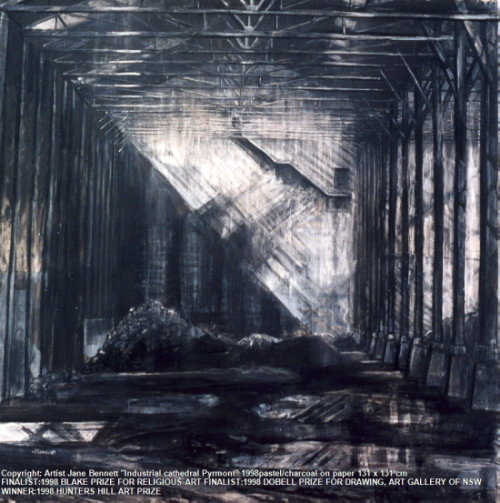
"Industrial Cathedral" charcoal on paper 131 x 131 cm Jane Bennett. Finalist in 1998 Dobell Drawing Prize Art Gallery of NSW Finalist 1998 Blake Prize Winner 1998 Hunter's Hill Open Art Prize

About Me

My photo
Sydney, NSW, Australia
I'm an Industrial Heritage Artist who paints "en plein air".If it's damaged, derelict, doomed and about to disappear, I'll be there to paint it.

Tuesday, 28 July 2020

In the pink -the former Pyrmont Arms Hotel, Harris Street Pyrmont

The former pub 'The Pyrmont Arms' was at 42-44 Harris Street, Pyrmont on the corner of Harris and Bowman Streets.
Built in the 1870s,it closed in the early 1990s when the CSR refinery and distillery were progressively shut down and demolished to make way for the Jackson's landing development. Since then, it has been renovated as retail outlets, restaurants and home units.

P248 The 'Pyrmont Arms' from the CSR 1
1990 oil on canvas 31 x 31cm
I first painted the Pyrmont Arms Hotel as a bird's eye view from the roof of the CSR refinery.I had been the 'Artist in Residence' at the CSR Refinery from the late 1980s to the start of its demolition in the mid 1990s. I had previously been painting at the top of the Panhouse, but one day in a fit of bravery I decided to paint from the top of the Boilerhouse next to the chimneys.
The CSR boilerhouse is now the site of the 'Elizabeth' apartment block of the Jackson's Landing LendLease development.
The Pyrmont Arms Hotel was then still an operating pub and was painted a grubby faded pale pinkish beige. On the back of the pub's western side facing the Scott Street squats, there was a huge ad for 'Have a cold gold KB', unfortunately not visible from my rooftop studio. Across the road was the brick facade of the CSR chem labs.
It didn't stand out from the rest of the rather dingy terraces at the 'Land's End' of Harris street, but what caught my eye was the contrast between the terraces and the overgrown area around the squats that was rapidly turning into a wilderness. I painted a small square canvas focussing on just the Pyrmont Arms, and resolved one day to paint a panorama of the northern end of Harris Street from this vantage point.

P249 'Pyrmont panorama- from the CSR '
1991 oil on canvas 46 x 92cm
A few months later, I climbed the many levels of revolting, sugar syrup encrusted stairs to the top of the CSR boilerhouse again, to paint this panorama, and was startled to find that the formerly almost unnoticeable pub had succumbed to a brash attempt at 'renovation'.
Weirdly, it shared the same revolting shade of pink with another dying pub at the other end of Pyrmont, the 'New York Hotel' in Edward Street, opposite the Pyrmont Power Station.
This fluoro paint job was such a product of its time that it defined the late 1980s to 1990s, a period without style or taste. I remember leggings and jumpers in that same fabulously horrid "glow in the dark" colour, possibly an over-reaction against the ochres and browns of the 1970s. In architecture, it was known not very fondly as "Paddington Pink" or "Paddo pink" for short, although the examples in Paddington itself were much more muted.

P248B 'The 'Pyrmont Arms' from the CSR 2'
1991 oil on canvas 31 x 31cm
It made the Pyrmont Arms stick out like a sore thumb from the dingy red brick warehouses and bond stores, and not in a good way.
I don't know if it was still an operating pub then or whether the new paint job was a desperate last ditch attempt to attract customers or preparation for its sale and possible redevelopment.
For the truth was that the pubs of Pyrmont were hanging by a thread. Their customers were gone with the destruction or relocation of the local industries that had employed them, and the industries of Pyrmont's future were yet to replace them.
The CSR Refinery and Distillery, which had replaced the sandstone quarrymen of northern Pyrmont a century before, was almost deserted and would be demolished and replaced with Jackson's Landing by the middle of the decade. But there was a strange interregnum before the new apartments were built and filled with inhabitants, and the northern end of Harris Street was a ghost town.
The iconic Terminus Hotel, only 2 blocks further up Harris Street, had already ceased trading a decade before, and stood abandoned, neglected and a constant source of speculation for the next 30 years, before its very recent renovation. How the 'Royal Pacific', later to be rechristened the 'Pyrmont Point'/ 'Point Hotel', ever kept on trading is a much bigger mystery that any of the urban myths swirling around the 30 year vacancy of the Terminus.
What is it with the lurid colour schemes inflicted on moribund pubs?
Far from Pyrmont, another doomed hotel, the 'Jolly Frog' also got the pink treatment not long before it suffered one of those mysterious fires that afflict abandoned buildings.
They must have used the same colourblind painter and decorator. And he must have got the paint at a huge discount, or it might have 'fallen off the back of a truck'.
Either way, it didn't work. All closed as pubs not long after.

P248C '42 Harris st -ex Pyrmont Arms'
2012 oil on canvas 31 x 31cm
The 'New York Hotel' has been painted a tasteful off-white, and is now a medical centre, of all things!
'The Pyrmont Arms' has now been painted a dull blue on the ground floor and a muted yellow for the upper floors. It is no longer a hotel, but has been reasonably sympathetically renovated and is now a combination of apartments above and a bottle-o below.
And the Jolly Frog, 6 years after its devastating fire, is still awaiting redevelopment.

Related Posts


Friday, 24 July 2020

A last look around the Harbour Control Tower

Today's painting on the deck gallery is a view of the much maligned and now demolished Harbour Control Tower.

Plein air oil painting of the Harbour Control Tower from the East Darling Harbour Wharf, now Barangaroo painted by Jane Bennett
BAR54 'Tower of Power' 2010
oil on canvas 61 x 61cm
Enquiries
It had many sarcastic nicknames : the "Pill" (controlling the berths in the Harbour, the "concrete mushroom", and even "the hypodermic in God's bum"!
But I think that the viewer of my canvas can find the same stern monumental dignity  that attracted me to it as a subject.

Plein air oil painting of the Harbour Control Tower from the East Darling Harbour Wharf, now Barangaroo painted by Jane Bennett
BAR54 'Tower of Power' 2010
oil on canvas 61 x 61cm
Enquiries
The Sydney Harbour Control Tower, which lingered for a while at the northern end of Barangaroo, was demolished over a period of eight months starting in March 2016.
Consisting of an 87m high concrete column topped by an observation room with utterly breath-taking views, it gave the Harbour Master and Port Operations officers an ideal position from which to oversee shipping movements around Sydney Harbour.
The tower was designed in 1972 after two ships collided in the shipping channel off the knuckle of the wharf at Millers Point.
It stood sentinel over Sydney Harbour from 1974-2011 giving continual supervision of shipping movements.
Sydney Ports relocated its harbour control operations to Port Botany in April 2011, leaving the tower to gather dust for 5 years.
Plein air oil painting of the Harbour Control Tower from the East Darling Harbour Wharf, now Barangaroo painted by Jane Bennett
DH159 The empty wharf
2007 oil on canvas 61 x 91cm
Enquiries
I am naturally biased - I had the run of the Harbour Control Tower as a studio for nearly a decade.
As well as painting spectacular views of Sydney from the top floor and the amenities level, I used it as a sort of exclamation point in many landscapes of the wharf and Millers point. This canvas of the empty wharf has the strange melancholy of a de Chirico and the light poles marching steadily toward the Tower echo rows of classical columns.
As a pictorial device, the Tower would give an otherwise mundane streetscape an extra frisson. The feeling of someone potentially observing the scene from above from those green angled windows gave an almost sinister dimension.

Plein air oil painting of the Harbour Control Tower from Dalgety road Millers Point painted by Jane Bennett
MP5 Harbour Tower & Dalgety Terrace 2
2014 acrylic on canvas 18 x 13cm
The decision to remove the tower was controversial.
The developers of Barangaroo had considered it an eyesore as the surrounding development transformed the former port into a millionaire’s playground.
Former Prime Minister Paul Keating, self-appointed Baron Haussman of Sydney, and never one to shy away from an argument, stated with his customary belligerence that the tower did not have a "shred of heritage about it" and that calls to keep it were "rancid reactionism".
But he would, wouldn't he.
With his nearly pathological hatred of industrial heritage, that sits oddly with his working class background, he was grimly determined to get rid of it and pitched relentlessly into anyone with a good word to say about the former wharf.

This article written in November 2014 in the Sydney Morning Herald has a photo of me 'en plein air', painting the Harbour Tower Paul Keating so despised.

The Office of Environment and Heritage had previously described the tower as being of state significance “for its pre-eminent role in the history and maritime operation of the Port of Sydney.The Tower demonstrates 35 years of 24/7 operation in the Port of Sydney from 1974-2009 as the Port Operations and Communications Centre providing supervisory control over the many thousands of shipping movements in Sydney Harbour every year,” the Office said in its previous listing of the tower as a heritage site.
After the Heritage Minister decided not to list the tower on the State Heritage Register, the NSW Government approved a development application from the Barangaroo Delivery Authority to remove the former Harbour Control Tower . In their words : 'in order to achieve a naturalistic form and character for the reserve that is consistent with the site’s concept plan'.
I can't think of anything less naturalistic than Barangaroo. For some reason it brings to mind a poem called aptly "Poetry" by Marianne Moore about an imaginary garden that had real toads in it.
But as in the poem, the developers and their cheerleaders have little time for anything that doesn't fit their very narrow definition of what is "useful". Certainly nothing as useless as heritage.


'same thing may be said for all of us—that we
do not admire what
we cannot understand.'

Excerpt from
"Poetry" by Marianne Moore

The National Trust  rejected a proposal by the Barangaroo Delivery Authority to demolish the tower while the City of Sydney council wanted it retained as an artwork or public lookout.

Some people suggested alternate uses for the empty tower: bungee jumping, abseiling, a viewing tower over Sydney Harbour, or a “pop-out” café.
However the Barangaroo Reserve project director Peter Funder said “We looked at a number of re-use options and it just wasn’t viable. It completes the vision we’re trying to deliver here of recreating the headland of Barangaroo.”
As for arguments about usefulness, you could also question what practical use does the Barangaroo Headland Park serve. It has allegedly been returned to the 1836 footprint, yet it is far from natural bushland, and the public certainly isn't permitted to hunt or fish there. So it is a construct - just as artificial as the concrete wharf it replaced.

This canvas painted in 2015 from the Stamford on Kent shows rows of lollipop like palm trees perched tier upon tier, as though on a giant wedding cake. The stairway to the top cuts through the cake like a knife cutting a slice out of the cake. Symmetrical and hierarchical, and as unlike real bushland as the horses on a carousel are from the living animals.


Plein air oil painting of the construction of Barangaroo Headland Park from the Stamford on Kent painted by Jane Bennett
MP45 Barangaroo Headland Park from the
Stamford on Kent 2015 oil on canvas 122 x 153cm
COLLECTION: MITCHELL LIBRARY, STATE LIBRARY OF NSW
Enquiries

Its main function seems to be as a distraction from the scale of the southern end.
A spoonful of sugar to make the development go down.
A sort of 'Trojan park' under which is smuggled the true purpose of Barangaroo; to separate punters from their money.
It's a pity that almost all evidence of Sydney as an industrial port has been wiped away. I certainly found poetry in it.
I can't get used to the lack of Tower in the streetscapes of Millers Point - they look strangely empty now.

Related Posts


Thursday, 23 July 2020

No Place like home - Plein air painting in Millers Point

Today's painting on the easel of my deck gallery feels appropriate for these uncertain times when many people have been confined to their home in unexpected lockdown and have been rethinking many things they previously took for granted. Such as the relationship between the individual,the community and the government.
Plein air oil painting of terrace in Lower Fort St Millers Point, painted by Jane Bennett on the easel of my deck gallery
Plein air painting on site with protest banner
MP22 '67 Lower Fort st - This is my home'
2014 oil on canvas 46 x 61cm
Enquiries


What makes a house a home?
Is it just a place, or is there something a bit more intangible and numinous?
Why is where you live so important?
Plein air oil painting of terrace in Lower Fort St Millers Point, painted by Jane Bennett on the easel of my deck gallery
Plein air painting on site with protest banner
MP22 '67 Lower Fort st - This is my home'
2014 oil on canvas 46 x 61cm
Enquiries


I had been painting the East Darling Harbour Wharves for at least a decade before the development of Barangaroo so radically transformed the nature of the western side of the Sydney CBD. Long before the consequences of the end of Sydney's Working Harbour were understood by the general public, I could see the knock-on effect and how it would change the shape of people's lives.
I increasingly started to paint in the streets of the Rocks and Millers Point,knowing that the departure of the heavy industry and shipping would leave this area once again vulnerable to developers and the government. Only a couple of decades earlier, similar pressures had been faced, and the push back from an alliance of residents and unions culminated in the Green Bans led by the revered Jack Mundey AO. Some redevelopment ensued, but residents were relocated into purpose-built social housing in the Sirius Apartments, and Millers Point mostly held its ground.
But this time seemed different.
Millers Point, a historic harbourside enclave with 19th-century terraced houses is only a stone's throw from the Sydney Harbour Bridge, Walsh Bay Wharves and the former East Darling Harbour Wharves (now Barangaroo).
The grand terraces of Lower Fort Street perch on the escarpment overlooking the Walsh Bay Wharves. They spent the last century owned by the Harbour Trust in its various manifestations, and run as 'residentials' for waterside workers. The wharves, stores and workers' housing were completely integrated. The tight knit community was composed of people whose families had worked on the wharves, in some cases over 5 generations.
Plein air painting of heritage terraces in Lower Fort Street Millers Point with protest banners painted by industrial heritage artist Jane Bennett
Plein air painting on site with protest banner
MP22 '67 Lower Fort st - This is my home'
2014 oil on canvas 46 x 61cm
Enquiries
In the 1980s the Millers Point residences passed from the control of the Maritime Services Board to that of the Department of Housing and there was a noticeable decline in service, repairs and maintenance of the properties.
In 2012 the NSW government decided that almost 300 public housing properties at Millers Point must be sold saying the revenue would contribute to the public housing budget although how exactly the money will be spent hasn’t yet been made transparent.
Plein air painting of heritage terraces in Lower Fort Street Millers Point with protest banners painted by industrial heritage artist Jane Bennett
Plein air painting on site with protest banner
 MP22 '67 Lower Fort st - This is my home'
2014 oil on canvas 46 x 61cm
Enquiries
You could easily tell which houses were still inhabited. Banners were hung over balconies, spray painted onto sheets in stencil letters: 'Millers Point Not 4 Sale'; 'Say No to the Total Sell Off of Public Assets'.
The ubiquitous Reg Mombassa designed protest T shirt of a skull smoking a cigar and wearing a top hat, flapped from every washing line.
I painted a series of canvases recording the protests.
Plein air painting of heritage terraces in Lower Fort Street Millers Point with protest banners painted by industrial heritage artist Jane Bennett
Plein air painting on site with protest banner
 MP22 '67 Lower Fort st - This is my home'
2014 oil on canvas 46 x 61cm
Enquiries
The most creative protest banner was a washing line "This is my Home" on the corner of lower Fort Street and Downshire Lane in the shadow of the Harbour Bridge. It summed up every emotion and argument in a single pithy line.
As I painted this, I became friends with its author, Sally.

The artist on site with the local wildlfe
while plein air painting on site
I adore lizards, especially blue tongues, and was very happy when Sally lent me her blue tongue lizard to cuddle. To protect it from the local cats, it had a refuge in the garbage bin left lying on its side. I'd wondered why the bins were apparently scattered randomly on the tree stumps, and then realized they were lizard havens filled with rocks, food and water for 6 out of 7 days, and only used briefly for their original purpose.
I returned to paint a much larger canvas, but soon after, some low life stole Sally's T shirts. She replaced them with a set of towels with another appropriate and thought-provoking motto,  "Age in place" stencilled on them.
Sally was a real character. Despite almost unbearable daily pressure from the authorities, she had the moxie to take the Government to court to try to remain in the home she had lived in for over 30 years.
Unfortunately after putting up a spirited fight, she eventually lost the case and was relocated against her will.

Related Posts

(Vanessa Berry's blog 'Mirror Sydney'- with a photo of me painting in High Street)

CLEARING HOUSE is the Tenants' Union of NSW's record of what's going on in Social and Affordable Housing portfolio redevelopment and renewal in New South Wales. They asked my permission to use my painting on this site.


Friday, 17 July 2020

Monet and Streeton meet Windsor Bridge

Windsor is one of the 'Macquarie towns' on the Hawkesbury River created in the early 19th century by Governor Lachlan Macquarie as the foodbowl of Sydney.
Plein air oil painting of the old Windsor Bridge painted by heritage artist Jane Bennett
 TSWB1 Windsor Bridge from western side
2013 acrylic on canvas 46 x 61cm


Thompson Square, established in 1795 at the centre of Windsor, is thought to be the oldest public square in Australia.
The old Windsor Bridge was a beam bridge built in 1874 for horse-drawn vehicles.
This canvas was painted in 2013 before NSW Roads and Maritime Services (RMS) department had started work on the replacement bridge, 35 metres (115 ft) downstream from the existing bridge.
The bank on the Freeman's Reach side of the Hawkesbury, where I painted this idyllic view marks exactly where the new bridge is now situated.
I painted these scenes in jacaranda flowering season as the bluish mauves offset the bright greens of the foreground.
Plein air oil painting of the old Windsor Bridge painted by heritage artist Jane Bennett
TSWB3 Windsor Bridge early morning from western side
2013 acrylic on canvas 46 x 61cm
Available
The old bridge is an austere construction with modestly proportioned piers and the engineering of the cross bracing  consistent with the challenges of its location.
Plein air oil painting of the Hawkesbury River from the old Windsor Bridge painted by heritage artist Jane Bennett
TSWB12 View from Windsor Bridge in jacaranda season
2015 oil on canvas 25 x 51cm
Available
As you can see from the painting above, the real charm of Windsor Bridge is revealled in its river vistas.
Monet would have loved this spot. And my gallerist, on seeing these works, did ask if I'd painted them in France.
This area certainly inspired Arthur Streeton, one of the Australian Impressionists, who painted his masterpiece "The Purple Noon's Transparent Might" not far from here.
Plein air oil painting of the construction of the new Windsor Bridge painted by heritage artist Jane Bennett
TSWB16 'Construction of the new Windsor Bridge' 2019
oil on canvas 91 x 183cm
Available
But now the timeless harmony of the sleepy river and the Georgian, Victorian and Federation architecture of Thompson Square has been surrounded by a maelstrom of excavation and construction.
Most of the old trees have now been felled.
The new bridge opened to traffic on 18th May 2020.
The new approach road rises up on a large visually intrusive embankment as it cuts a swathe  through the square.
There is now a bitter battle to save the 140 year old bridge from demolition. The RMS has stated that it will start removal in the coming months, but many would prefer the old bridge to be restored and left in situ. 

Related posts