I wanted to try painting a large canvas of the spectacular view of Goat Island from Moore's Wharf for my solo exhibition "From the Hungry Mile to Barangaroo" which is now on display at the Frances Keevil Gallery.
I never do anything by halves, so I got the biggest canvas that would fit inside my station wagon - 122 x 183cm!
I was worried about the canvas going hang-gliding over Sydney Harbour, or
even snapping in two which happened while I was painting the Sydney Heritage Fleet from Blackwattle Bay.
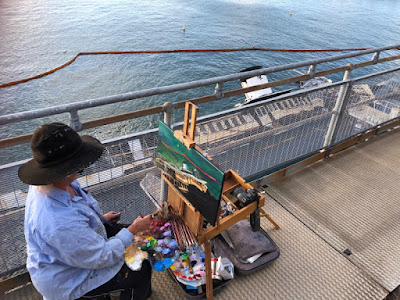
The solution was to take a studio easel rather than a French box easel, and to use cable ties to secure the canvas to the easel, and the easel to a large chunk of timber.
The most important thing is not to forget to bring a good sharp pair of scissors to remove the cable ties!
 |
| I've had to cable tie the large canvas to my studio easel |
The renowned 19th century marine painter
J.M.W.Turner used to boast that he was once "lashed to the mast" to witness a storm at sea as inspiration.
 |
I've had to cable tie the large canvas to my studio easel- and then cable tie the easel to a timber block!
|
I've always loved Turner's paintings and now I feel that I am literally following in his footsteps!
 |
| Timber block and easel |
Quite literally.
Like Turner,who also had a predilection for painting enormous canvases, I'm also very short, so I had to stand on this useful block of wood so I could reach up to paint the sky!
 |
| Timber block and easel used by plein air painter Jane Bennett |
It felt like a long way down!
 |
Starting a large plein air painting of Goat Island from Moore's Wharf about 7.30am.
I like to prime the canvas with a coloured ground before I paint. This technique is called "imprimatura" and it helps to reduce the glare reflected by a white canvas outdoors, as well as giving more depth to the tones.
Usually I prime a canvas blue when I'm about to paint Sydney Harbour, but this black primed canvas was originally intended for an interior of the Eveleigh Railway workshops.
|
 |
| My large plein air painting of Goat Island from Moore's Wharf at about 8am |
Black actually turned out to be a good choice.
The day started bright and sunny, but the clouds gathered quickly.
The calm morning Sydney Harbour seascape I had originally intended to paint was soon transformed into a brooding study of an impending storm.
 |
| My large plein air painting of Goat Island from Moore's Wharf at about 9am |
Plein air painting is full of abrupt changes of mood and direction, which is why I enjoy it so much.
It feels almost as much like a sport as art.
The amount of physical strength involved in just being able to handle a canvas of this size out in the open air is surprising.
The other thing that is underestimated by the people who view the finished canvas in a pristine white-walled gallery, is the amount of concentration required to sustain the atmosphere over the hours required to finish a work of this size.
 |
| My large plein air painting of Goat Island from Moore's Wharf at about 9.30am |
Light, shadow and colours of the sea and sky change constantly, and it takes the reflexes of an elite tennis player to even attempt to capture these fleeting effects.
 |
| My large plein air painting of Goat Island from Moore's Wharf at about 10am |
Apart from the skill needed to paint these fleeting effects, it also takes a great deal of experience and judgement to decide which are worth capturing.
 |
| My large plein air painting of Goat Island from Moore's Wharf at about 11am |
By noon, I had most of the canvas painted,and it was looking very promising, but an hour later the weather had changed dramatically.
Dark clouds started to cover the sky and the sea changed colour from turquoise to prussian blue, then to slate grey.
The wind whipped up, and I had to decide whether it was too risky to continue.
 |
| My large plein air painting of Goat Island from Moore's Wharf at about noon |
If I decided to continue the painting on another day with similar weather conditions, there was the risk of not being able to complete it in time for my exhibition. On the other hand, if I pressed on, it might get so windy that it would be physically dangerous to keep on painting.
I had almost as much canvas to cope with as some of the smaller yachts out on the harbour, who were starting to have trouble.
And if I wasn't careful, my canvas would have travelled just as fast in the wrong direction!
 |
| My large plein air painting of Goat Island from Moore's Wharf at about noon |
Also, the colour, mood and light conditions were so different from when I started that it would mean repainting almost everything!
The sensible choice probably would have been to put the canvas away and start a small study of the stormy conditions.
But I liked the dramatic light effects so much that I took a calculated risk and quickly repainted the canvas to reflect the changed conditions.
 |
The completed canvas
| 'Storm, Goat Island' 2013 oil on canvas 122 x 183cm |
$15,000
Enquiries about this painting
|
I had to work very quickly. I didn't dare take a break for lunch in case my canvas wouldn't be there when I got back.
But I'm glad that I took the risk, as the canvas has really captured the colour and mood.
The brilliant yellow buoys surrounding the excavation of the North Barangaroo Headland Park contrast strongly with the ominous sky and dark, choppy sea.
 |
| 'Storm, Goat Island' 2013 oil on canvas 122 x 183cm |
$15,000
Enquiries about this painting
|
Art vs. life!
 |
| 'Storm, Goat Island' 2013 oil on canvas 122 x 183cm |
$15,000
Enquiries about this painting
|
This photo best shows the painting in context with the landscape.
However large the canvas actually is, it will always look like a postage stamp compared with the real thing. I can assure you that this canvas is a lot bigger than I am!
By the time I took these photos, I was so worried about the canvas blowing away that I had to cable tie it to the container - I didn't dare risk putting it on the easel!
.JPG) |
| 'Storm, Goat Island' 2013 oil on canvas 122 x 183cm |
$15,000
Enquiries about this painting
|
And finally, here it is hanging in my solo exhibition.